Some links on this page are affiliate links. This means I may earn a commission if you sign up through these links, at no extra cost to you. I only recommend services I have personally used and genuinely believe can help serious English learners improve their confidence.
Don’t lose your cashback over avoidable mistakes.
Lingoda Sprint can be a powerful way to finally build a serious English habit. But the rules are strict. One missed class, one bad schedule decision, or one misunderstood rule can cost you the cashback.
If you want the reward, the confidence, and the feeling of “I actually stuck with it,” this guide will help you understand the rules before you join.
Quick Answer
Lingoda Sprint cashback is real — but you have to protect it.
Under the current 2026 Sprint Rules, Super Sprint requires 30 group classes per month for a 100% Reward, while Regular Sprint requires 15 group classes per month for a 50% Reward.
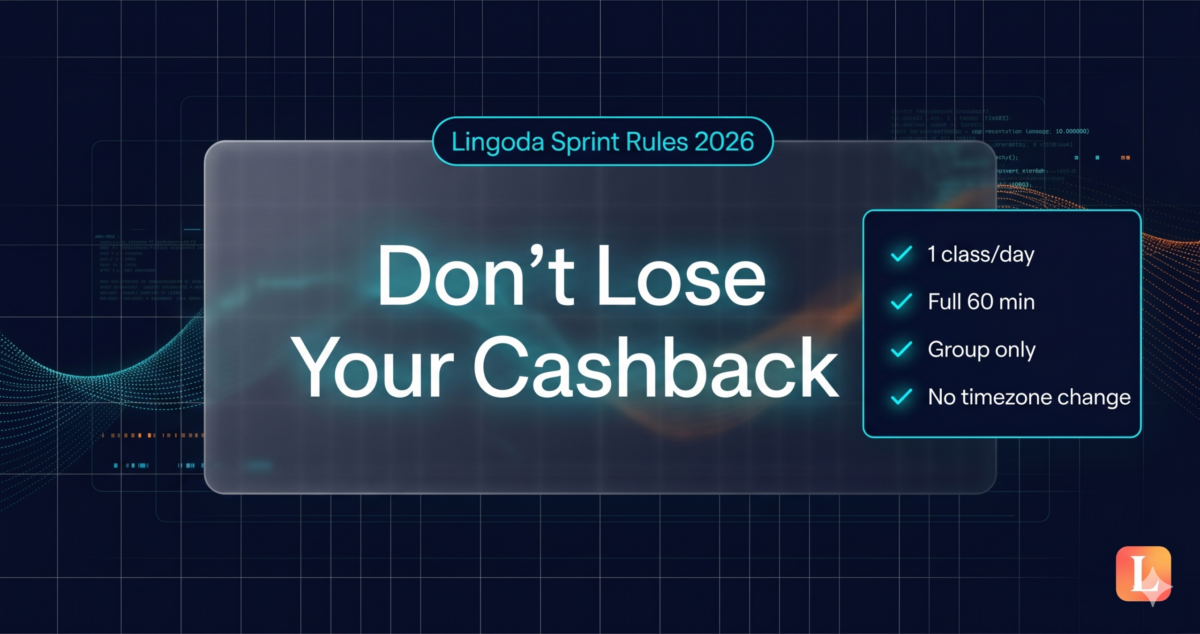
The fastest ways to lose your cashback are simple: miss a class, attend more than one class per day, break the weekly limit for Regular Sprint, leave before the 60-minute class ends, use private classes, change your time-zone settings, or forget about the subscription rollover after Sprint.
In other words: Sprint is not impossible. But you need a plan before you start.
Why This Matters
You are not just protecting cashback. You are protecting momentum.
The real appeal of Lingoda Sprint is not only the refund. It is the pressure. When you know you have to show up, you stop treating English like something you will do “when you have time.”
That structure can be exactly what busy English learners need. You book classes, show up, speak regularly, and start feeling that your English is no longer just something you study — it becomes something you actually use.
But that same structure is also why the rules matter. If your schedule collapses, the cashback can disappear with it.
Current Sprint Rules
Lingoda Sprint 2026: Dates, class targets, and cashback
The current Sprint runs for two months. According to the latest Sprint Rules, the key dates are:
May 4, 2026, 09:59 CET
May 11, 2026, 00:00
July 9, 2026, 23:59
Two Sprint months
The Sprint months are divided like this:
| Sprint month | Period |
|---|---|
| Month 1 | May 11, 2026 to June 9, 2026 |
| Month 2 | June 10, 2026 to July 9, 2026 |
You can choose between two Sprint options:
Super Sprint
- 30 group classes in Month 1
- 30 group classes in Month 2
- Reward: 100% of paid fees
- Best for learners who can commit almost daily
Regular Sprint
- 15 group classes in Month 1
- 15 group classes in Month 2
- Reward: 50% of paid fees
- Best for busy learners who need more breathing room
Cashback Killers
The mistakes that can make you lose your cashback
If you only remember one thing, remember this: Lingoda Sprint is a pass/fail challenge. Most people do not fail because the goal is impossible. They fail because they underestimate small rules.
| Mistake | Why it can cost you cashback | How to avoid it |
|---|---|---|
| Taking more than one class per day | The current Sprint Rules say customers may only attend one class per day. More than one class per day disqualifies you from the Reward. | Schedule only one class per day in your Lingoda account time zone. |
| Taking more than 5 classes per week in Regular Sprint | Regular Sprint customers may only attend up to 5 classes per week. A week runs Monday to Sunday. | If you choose Regular Sprint, never book 6 classes in the same Monday–Sunday week. |
| Not attending the full 60 minutes | A class only counts if you attend fully from the beginning and do not leave before the end. | Join early, test your internet, and protect the full hour. |
| Missing a class for any reason | Absence does not count toward the Reward, even for health, work, technical, weather, or personal reasons, unless Lingoda is responsible. | Build a schedule that survives your worst week, not your ideal week. |
| Booking private classes | Private classes do not count toward the Reward. Only group classes count. | Make sure every Sprint class you book is an eligible group class. |
| Canceling too late | You may only cancel no later than 7 days / 168 hours before the class, or within the 30-minute immediate-cancel window in your Lingoda account. | Book carefully. Avoid last-minute reshuffling. |
| Changing your time-zone settings | Changing your Lingoda account time zone during Sprint can disqualify you because it could allow more than one class per day. | Do not change your account time zone during Sprint. If you travel, plan around your original time zone. |
| Using non-Sprint credits | Only credits specifically issued for the Sprint count toward the Reward. Extra purchased credits do not qualify. | Use only Sprint credits for Sprint classes. |
| Payment or account problems | Late payment, unresolved chargebacks, multiple Sprint registrations, account sharing, or multiple users on one account can disqualify you. | Use one account, one payment method, and make sure your Month 2 payment goes through. |
Not sure if Sprint is too strict for your life?
That hesitation is healthy. Sprint can be amazing if your routine is stable, but risky if your schedule changes every week. Before committing to a two-month challenge, try one Lingoda class and see whether the teachers, lesson pace, and platform fit you.
Try Lingoda Before Joining Sprint →Classes That Count
Not every class protects your cashback.
This is where some learners make expensive assumptions. For Sprint, you need classes that count toward the Reward. Under the current rules, only eligible group classes count. Private classes do not count.
You must attend the class from the beginning and stay until the end of the 60-minute lesson.
Private classes do not contribute toward the Reward.
Only the credits issued specifically for Sprint count toward the Sprint Reward.
You cannot fix a missed Sprint requirement by buying additional credits.
If Lingoda is responsible for a class not taking place, Lingoda may refund the credit within 72 hours, and the class can still count toward the Reward under the Sprint Rules.
Scheduling Rules
Your schedule is the real battlefield.
The cashback is not only about motivation. It is about calendar control. If you treat Sprint like a casual course, you are more likely to lose the Reward. If you treat it like a fixed appointment, your odds improve dramatically.
Book at least 7 days ahead
Lingoda recommends booking at least 7 days in advance to secure your desired time, date, and level.
Cancel only within the safe window
You may only cancel no later than 7 days / 168 hours before class, or within the 30-minute immediate-cancel window.
Do not rely on the final days
Finishing early is safer than trying to save your cashback in the last 48 hours.
Protect one stable time slot
Early morning often works better for busy professionals because fewer people can steal that time.
The Real Reward
Cashback is nice. But confidence is the bigger win.
Yes, the cashback matters. Nobody wants to lose money over a small mistake. But the deeper reason Sprint works is that it forces you to show up.
When you speak English regularly, something changes. You stop overthinking every sentence. You start responding faster. You understand more. You feel less like a “student” and more like someone who can actually use English.
That feeling — the confidence that English is becoming part of your real life — is the reason Sprint can be worth the pressure.
After Sprint
Do not forget the rollover subscription.
One of the easiest things to overlook is what happens after the Sprint ends. By joining Sprint, you agree to a monthly recurring subscription after the Sprint, known as the Rollover.
Keep Running Pack
- 20 classes per month
- Continues after Sprint unless canceled
- Check the price in your account
Keep Running Pack
- 12 classes per month
- Continues after Sprint unless canceled
- Check the price in your account
You are entitled to cancel the Rollover within the second month up to the Sprint End Date. If you do not want the subscription to continue after Sprint, set a reminder and cancel before the Sprint ends.
Should You Join?
Sprint is best for learners who want pressure, not comfort.
Sprint may be worth it if…
- You want a strong reason to study consistently.
- You can protect a fixed class time.
- You like clear goals and external pressure.
- You are serious about improving your speaking confidence.
- You can plan ahead and avoid last-minute changes.
Sprint may be too risky if…
- Your schedule changes often.
- You travel across time zones during the Sprint.
- You may cancel classes at the last minute.
- You mainly want casual conversation practice.
- You are joining only because the cashback looks attractive.
Protect Your Cashback
How to avoid the mistakes before they happen
Plan your classes before your calendar gets crowded.
Pick a time that work, family, and fatigue are least likely to destroy.
Do not assume private classes will count toward Sprint.
One class per day. Regular Sprint: max 5 classes per Monday–Sunday week.
If you travel, plan around your original Lingoda account time zone.
Join early and avoid unstable internet, noisy rooms, or rushed schedules.
Make sure your Month 2 payment succeeds.
Cancel before the end date if you do not want the subscription to continue.
Read Next
Build your Sprint plan before you join
If you are serious about Sprint, do not stop at the rules. Check the failure patterns, schedule logic, and refund details before you commit.
Final Verdict
Cashback is real. But your routine decides whether you keep it.
Lingoda Sprint can be worth it if you want structure, pressure, and a real reason to speak English consistently. But the cashback is not something to casually chase. You need to protect your schedule, follow the rules, and avoid small mistakes.
If you are still unsure, start smaller. Take one Lingoda class first. Feel the lesson pace, test the platform, and decide whether Sprint is the right challenge for your life.