
Lingoda Sprint rules are strict because the reward is based on completion, not good intentions. If you are searching for the rules, the real question is whether your actual calendar can survive the attendance, booking, cancellation and rollover checks.
As of July 7, 2026, Lingoda’s public Sprint page shows the next Sprint start as July 27, 2026, with a two-month challenge, 15 or 30 live online group classes per month, and a reward that can be paid as cashback or class credits if the rules are followed. Always confirm the current official rules before paying, because dates, prices and cohort terms can change.
Biggest risk
One missed learner-side class, a wrong class type, or too many classes can remove the reward even if you keep studying.
Best reader fit
Sprint fits people with a predictable two-month calendar, early booking habits and no travel chaos.
Safer next step
Read the rules as a planning test before treating the cashback headline as a discount.
Lingoda Sprint rules in one minute
The simple version is this: Lingoda Sprint rewards learners who complete the exact class target during the exact Sprint months while staying inside the booking, attendance and account rules. Motivation helps, but the rule system decides the reward.
For example, a learner who can study every evening may still be a poor Sprint fit if work travel, family care or unstable internet makes one full live class every day or every second day unrealistic.
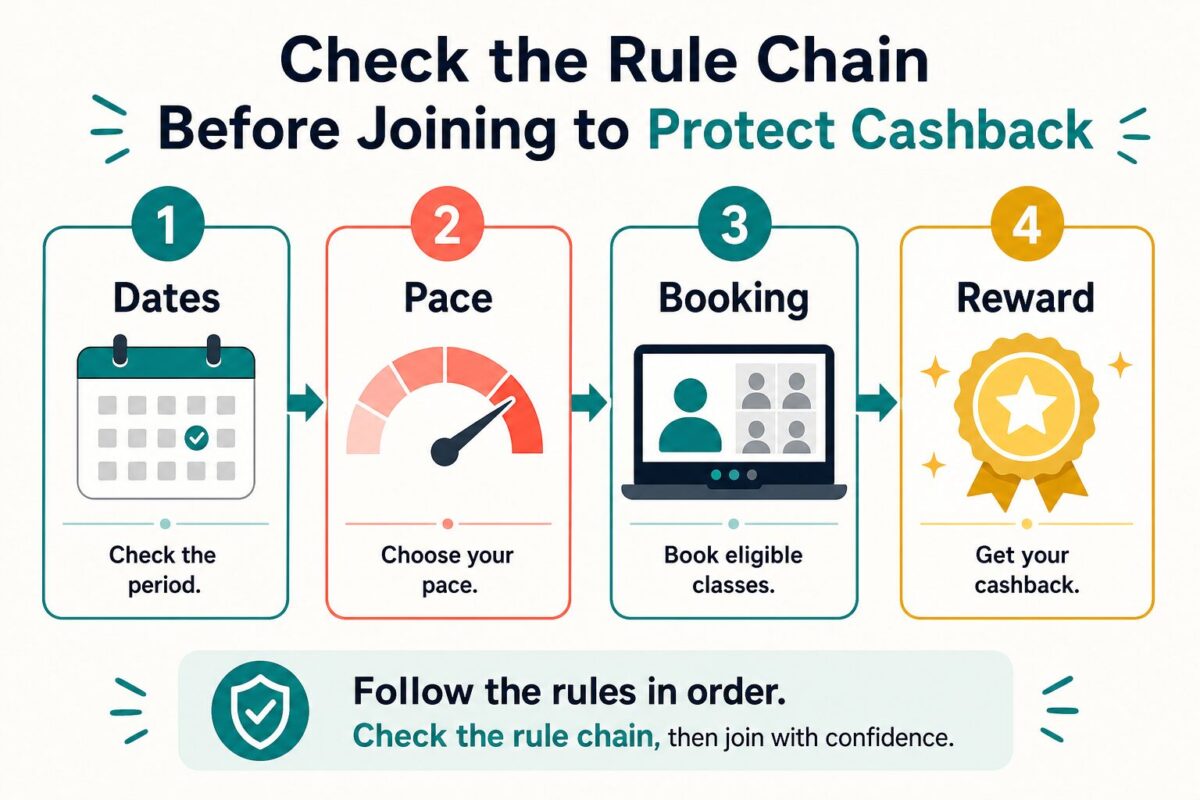
| Rule area | What to check before joining | Why it matters |
|---|---|---|
| Class target | Sprint is 30 group classes over two months; Super Sprint is 60 group classes over two months. | The reward depends on completing the correct number in the correct period. |
| Daily limit | Do not take more than one Sprint class per day. | Trying to catch up by stacking classes can break eligibility. |
| Weekly limit | Regular Sprint has a weekly limit; Super Sprint has a higher weekly limit. | A weekly plan that looks fine on paper can still exceed the rules. |
| Class type | Use eligible group classes for the Sprint reward. | Private or non-Sprint credits may not count toward the reward. |
| Rollover | Check what happens after the two-month Sprint ends. | Many learners focus on classes and forget the post-Sprint subscription decision. |
What gets you disqualified from Lingoda Sprint cashback?
The highest-risk mistakes are not dramatic. They are small calendar mistakes that make your class record stop matching the Sprint terms.
Lingoda’s rules and FAQ emphasize full attendance, class-count limits, eligible group classes, cancellation timing and account/payment conditions. If those checks fail, you may keep access to paid classes but lose reward eligibility.
Missing a class for your own reason is the expensive mistake
If you miss class because of your own schedule, internet, microphone, travel or personal issue, you should treat the reward as at risk. The official FAQ separates confirmed Lingoda-side issues from learner-side problems.
Example case: you book a 7 a.m. class before a business trip, sleep through it after a late flight, and plan to take two classes the next day. That feels like a reasonable human recovery plan, but it is not a safe Sprint recovery plan.
Taking extra classes can hurt instead of help
Sprint is not a flexible bank of credits. The class target belongs to a defined Sprint runtime. Taking more than the allowed number, using credited classes at the wrong time, or trying to make up for a mistake can create a second problem.
This is where many learners get trapped. They think, “I paid for the classes, so more effort should help.” For Sprint, the safer mindset is: follow the exact allowed pattern first, then learn as much as you can inside it.
Do not use cashback as your only reason to join. If losing the reward would make the course feel unaffordable, the rules are probably too financially stressful for your situation.
Attendance rules: join on time, stay through class, protect the record
Attendance is the heart of the Sprint. You need each required class to count as completed inside the Sprint runtime. That means joining from the start, staying through the live class and avoiding anything that could make the class record ambiguous.
The official Sprint terms say classes must be fully attended and refer to system information and teacher information. In practical terms, do not treat the first or last minutes as optional.
What if the teacher or platform causes the problem?
Official guidance gives different treatment when the class problem is on Lingoda’s side. If that happens, keep proof, contact support quickly and do not use any refunded credit during the Sprint unless the current rules clearly allow it.
A realistic case: the teacher does not show, Lingoda refunds the credit, and you immediately book another class during the same Sprint month. That may feel proactive, but the FAQ warns that using credited classes during Sprint can create an additional-class problem.
What if you are a few minutes late?
Lingoda’s FAQ says a small teacher or student delay does not necessarily disqualify you as long as you do not miss more than 10 minutes. Still, the safest behavior is to enter early and test your mic, camera and internet before class starts.
This is not about perfectionism. It is about avoiding a support dispute over a class log when the reward is worth hundreds of euros.
Booking and cancellation rules are where careful learners still fail
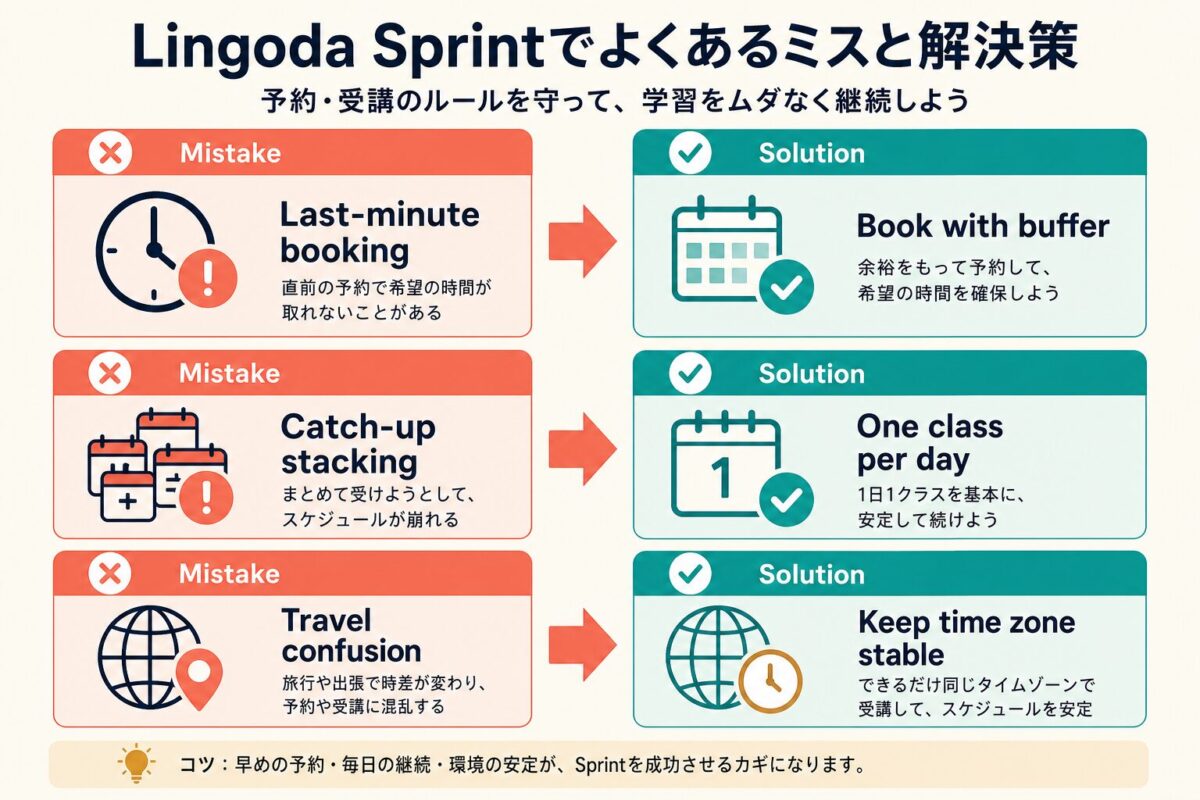
The dangerous pattern is waiting until the end of the month to book the remaining classes. Lingoda advises booking at least seven days in advance, and the FAQ says cancellation normally needs seven days unless you use the immediate cancellation window after booking.
If your work schedule changes often, Sprint can become a second job. You are not just learning a language. You are also managing a two-month attendance project with limited recovery space.
Booking early is not just convenience
Early booking reduces two risks at once: no suitable class at your level, and no safe cancellation room if life changes. The rule risk rises when you need the platform to fit a chaotic week perfectly.
For example, a parent who can study only after children sleep may need very specific late-night slots. If those slots are not reliably available, a normal Lingoda plan may be safer than Sprint.
Daily and weekly limits: the catch-up trap
The rule many readers underestimate is the class limit. Official FAQ language says you cannot take more than one class per day during Sprint, and it also lists weekly limits for Sprint and Super Sprint.
That changes the way you should plan. A regular course lets you recover from a busy Tuesday with two classes on Saturday. Sprint does not reward that kind of flexibility.
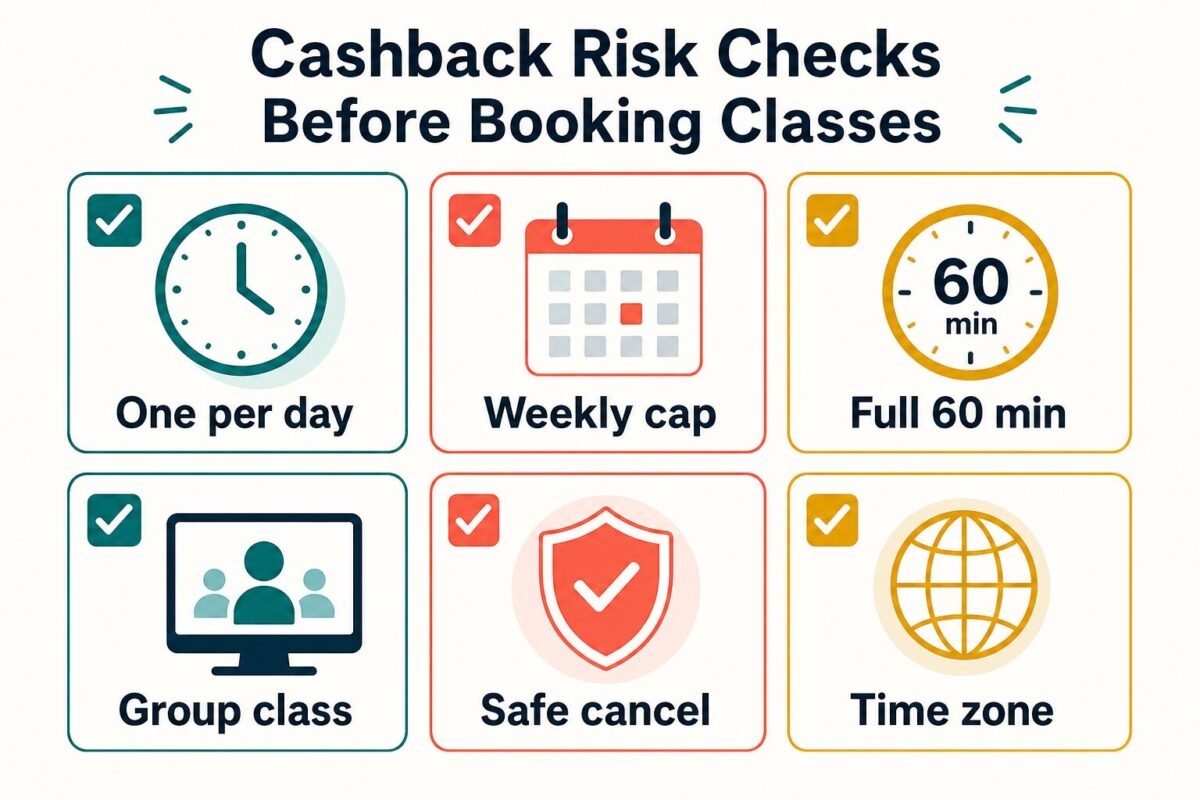
| Situation | Normal learner instinct | Safer Sprint judgment |
|---|---|---|
| You miss one class | Take two tomorrow. | Do not assume catch-up is allowed; check the current rules first. |
| You have a free weekend | Book several classes together. | Sprint limits can make that risky even if classes are available. |
| You travel across time zones | Use whatever local time looks open. | Plan from the account time zone and avoid date confusion. |
| You receive a refunded credit | Use it quickly. | Do not use it during Sprint if it creates an extra-class issue. |
Time zones and travel can break a perfect plan
Time-zone confusion is one of the most painful Sprint risks because it looks like a small admin issue until it affects the class day. Official rules warn that changing time-zone settings can matter because it could enable more than one class per day.
If you will travel during the two Sprint months, build the plan before paying. Do not assume you can fix the calendar after the first problem appears.
Example case, not a testimonial: Maya lives in New York, travels to Berlin for ten days, and sees a class that looks like Tuesday night in one calendar and Wednesday morning in another. The language study is not the hard part. The hard part is proving the class record still fits the Sprint day and weekly limit.
Who should avoid Sprint during a travel-heavy month?
Avoid Sprint if you cannot control your class environment. Weak hotel Wi-Fi, family visits, conference dinners and jet lag are not moral failures. They are practical rule risks.
If your two months include travel, a regular Lingoda plan can still help you speak more. The difference is that a regular plan does not put the reward behind perfect calendar behavior.
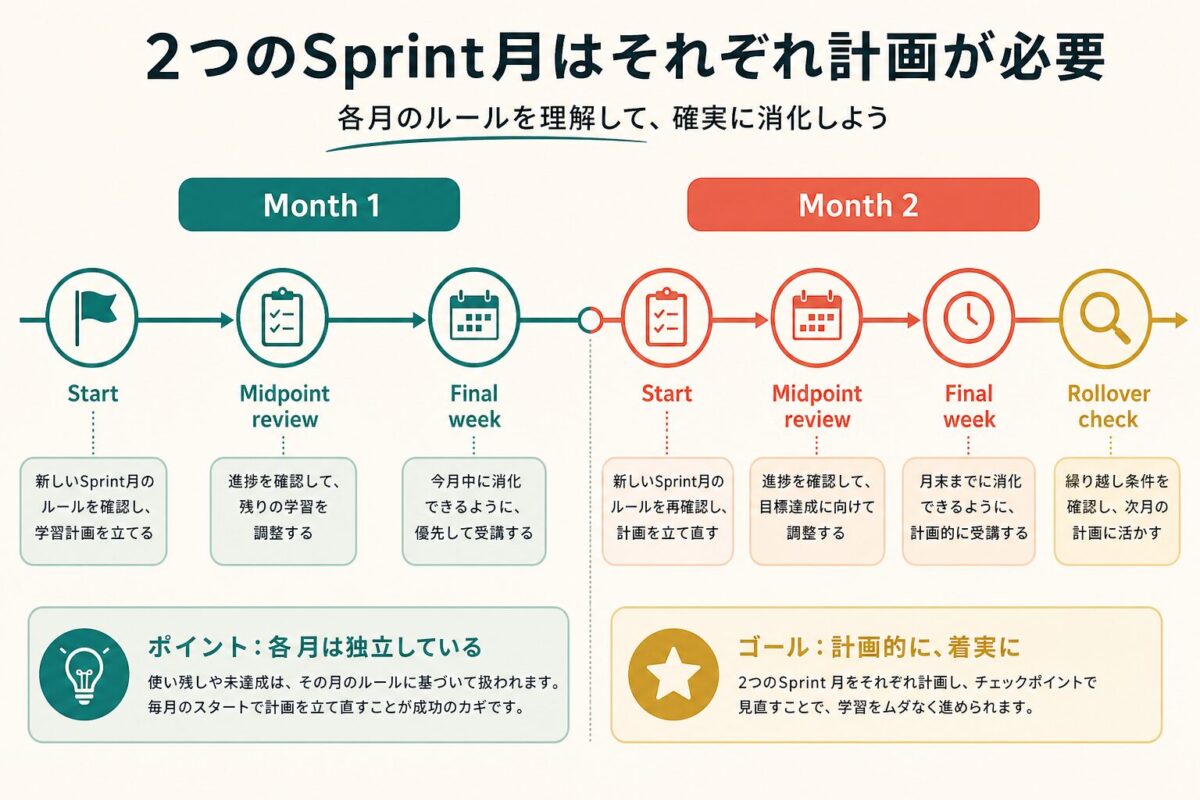
Rollover and payment rules: do not forget the end of Sprint
Many readers focus on the first payment and the reward, then miss the post-Sprint subscription question. Lingoda’s current Sprint page says the course rolls over to a regular subscription after the promotion unless you change the post-Sprint subscription during the last month.
That means your checklist should include the final decision date, not only the first class date. The expensive surprise is not always disqualification. Sometimes it is forgetting what happens after the challenge.
| Before paying | During Sprint | Final month |
|---|---|---|
| Confirm current cohort dates, total price and payment schedule. | Track attendance, class count and support emails. | Decide whether to continue, pause or change the post-Sprint plan. |
| Read the PDF rules and official FAQ. | Save screenshots of unclear class issues. | Do not wait until the last day to understand rollover. |
| Stress-test your real calendar. | Book ahead instead of relying on last-minute availability. | Keep reward email and payment proof together. |
Is Lingoda Sprint worth it?
Sprint is worth considering if the two-month deadline makes you study consistently and the reward would be a bonus, not a financial lifeline. It is risky if the cashback is the only way the course makes sense for your budget.
The honest before-and-after is simple. Before Sprint, you may be stuck in vague self-study. After a well-planned Sprint, you have a fixed speaking schedule. But if the schedule does not fit your life, the same structure can become expensive pressure.
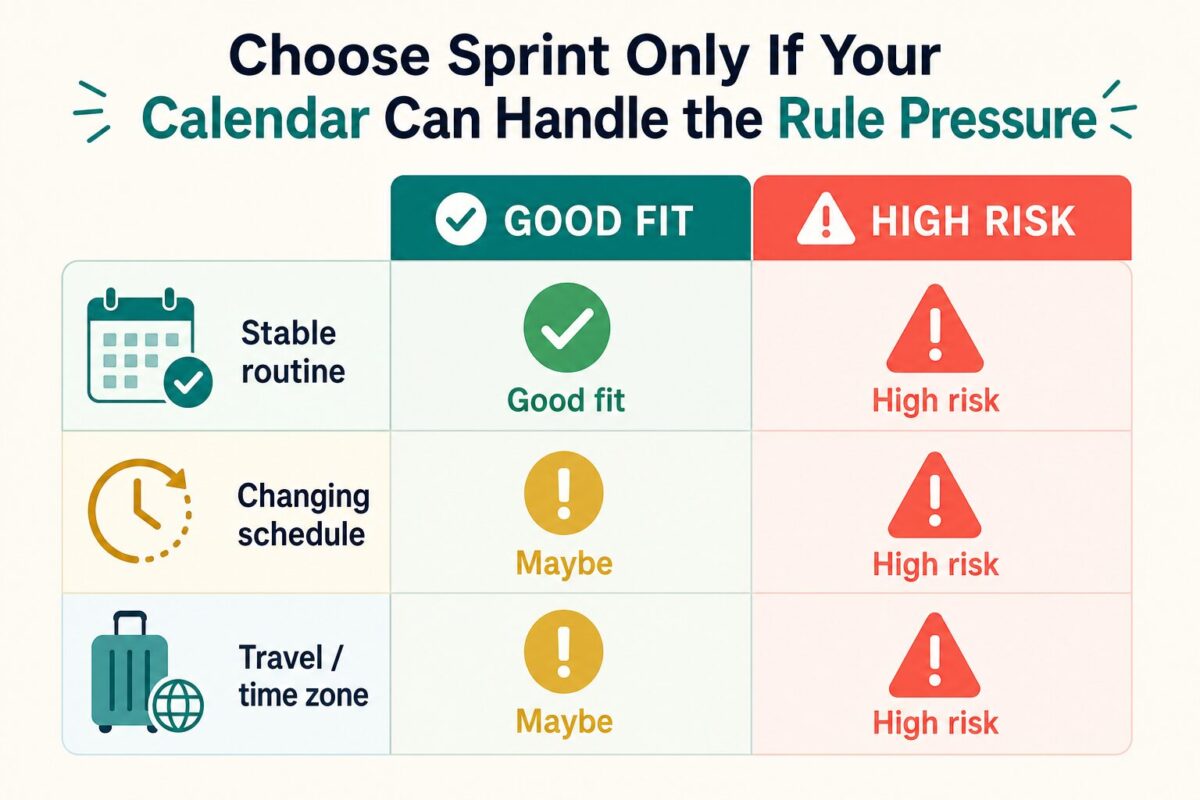
Sprint fits you if your calendar is boring in a good way
Choose Sprint only if you can say where you will be, when you will take classes and how you will protect those slots for two months. Predictability is not boring here. It is the main requirement.
Example case: a remote worker with stable evenings, reliable internet and no major travel can turn Sprint into a useful accountability system.
Sprint may not fit if your life needs flexible recovery
Do not choose Sprint if you often need to move commitments at the last minute. You may still benefit from Lingoda, but a standard plan may protect your money and attention better.
Example case: a nurse, consultant, parent of a small child or frequent traveler may need flexibility more than cashback pressure.
How to decide before joining Lingoda Sprint
Do not start with the cashback headline. Start with a calendar audit. If the calendar passes, then check price, level, language, teachers and practice fit.
This order matters because a better price does not solve a bad schedule. If your schedule fails, the most rational decision is to use a normal plan or a different speaking routine.
Green flags
You can book early, attend the same time most days, avoid travel, keep proof, and handle the cost even if the reward is delayed.
Red flags
You need last-minute changes, travel often, share devices, rely on unstable Wi-Fi, or need cashback to make the course affordable.
Official checks to make before you pay
Use this page as a plain-English guide, not as a replacement for the official rules. Before joining, open the current Lingoda Sprint page, the pricing page, the FAQ and the PDF rules for your cohort.
As of the July 2026 public page, Lingoda lists a July 27 start, a July 14 entry deadline, two Sprint months ending September 24, 2026, and prices shown in euros. Those details are time-sensitive, so verify them again on the official pages before you pay.
Fast check: if you cannot explain the class target, daily limit, weekly limit, cancellation window, payment dates and rollover plan in your own words, do not pay yet. Read the official terms first.
Need the date view?
Use the Sprint dates checklist if you want to map the two months before paying.
Need the booking view?
Use the booking and cancellation guide if your schedule changes often.
Need the cost view?
Compare the Lingoda pricing guide and the free trial guide before choosing Sprint.
Use Sprint as a rule-fit decision, not a discount promise.
First check the current official rules. Then compare whether Sprint, a regular Lingoda plan, or a more flexible speaking routine fits your next two months.
FAQ about Lingoda Sprint rules
Can I take more than one Lingoda Sprint class in a day?
No, do not plan more than one Sprint class per day. Official guidance says learners cannot take more than one class per day during Sprint, and older PDF rules also treat extra daily classes as a disqualification risk.
Can I miss one class and still get cashback?
Assume no if the missed class is due to your own reason. Lingoda’s current FAQ says learner-side missed classes are not refunded and are not eligible for cashback.
Do private classes count toward Lingoda Sprint?
Do not rely on private classes for the Sprint reward. The official Sprint pricing page and PDF rules point to group classes as the relevant class type.
When should I book Lingoda Sprint classes?
Book early. Lingoda’s FAQ advises booking at least seven days in advance, and late booking creates availability and cancellation risks.
What happens after Lingoda Sprint ends?
The Sprint can roll over into a regular subscription. Check the current rollover rule during the final Sprint month and decide whether to continue before the promotion ends.
Is Lingoda Sprint better than a regular plan?
Only if the challenge structure fits your real calendar. If you need flexible recovery, a regular plan may be safer even if the headline reward is smaller.